
Tamim and Reem: An Arab Platform Reshaping the Future of Education for Deaf Children
Research article  Open access |
Available online on: 27 January, 2026 |
Last update: 27 January, 2026
Open access |
Available online on: 27 January, 2026 |
Last update: 27 January, 2026
Abstract:
Tamim and Reem is the first innovative educational platform in the Arab world specifically designed for children with hearing disabilities between the ages of 3 and 12. The platform seeks to bridge the significant gap in their education by providing content both in Arabic and sign language, enabling children to learn in their native language in a visually engaging way. The platform integrates education, entertainment, and modern technology, offering interactive educational curricula, 3D animated content, stories translated into sign language, and educational games based on visual interaction and stimulation.
The platform’s impact extends beyond children to families and teachers, providing them with educational and visual tools that enhance effective communication and support the inclusion of deaf children in an inclusive learning environment. Through a Learning Management System (LMS), a mobile application, and a responsive website, educational resources can be easily accessed anytime, anywhere. The project aims to bring about a qualitative and sustainable change in the education of deaf children by building a more inclusive environment that supports their right to learn and grow.
Keywords: Deaf Education; Sign Language; Inclusive Learning; Assistive Technology; Tamim and Reem; Children with Hearing Impairments; Deaf Children; Arabic Language Education.
Introduction
The Situation in the Arab World
Every child has the right to learn in their own language, yet millions of deaf children still lack this basic right. Although these children possess the same abilities and aspirations as their peers, the educational reality poses significant barriers to their education, including poor academic achievement and a low chance of completing secondary education, with the percentage remaining extremely low compared to others [1], [2].
The Situation in Jordan
As for Jordan, approximately 200,000 people over the age of five are hearing impaired, representing 3.1% of the population [2]. Despite this, the educational challenges facing these children remain significant, ranging from poor Arabic language skills [3] and a lack of dedicated curricula to high school dropout rates.
Based on this reality, the “Tamim and Reem” platform was created, the first bilingual Arab educational platform (sign language and Arabic), specifically designed to meet the needs of deaf children and provide them with a new opportunity for learning and integration.
The Story Behind the Innovation
The Beginning with Ma’moun Odeh
The story began with Ma’moun Odeh, a young Jordanian man born deaf in an environment unprepared to meet his educational needs. He couldn’t find a book in his language, nor any visual content that reflected his reality, but he decided to turn this challenge into an opportunity. Through four years of self-study, Ma’moun mastered the art of designing and animating 3D cartoon characters using 3D Blender and other tools, creating visual content that deaf children could understand.
What’s unique about this project is that it’s led by a deaf pioneer who lived the experience in every detail, giving it an authenticity and exceptional value unmatched by any other initiative. Ma’moun wasn’t just a developer or designer; he was a voice from within the community, fully aware of what deaf children need to feel included and understood.
The Role of Heba Jamjoum and the Family
Alongside Ma’moun was his wife, Heba Jamjoum, who learned sign language out of a love and desire to communicate with him. She later obtained a Trainer of Trainers (TOT) certificate. With the birth of their two children, Tamim and Reem, it was only natural for them to learn sign language to communicate with their father. From there, the family story transformed into a pioneering project bearing the names of their two children, Tamim and Reem, not only as a symbol of the family, but also because their names are composed of labial letters that are easy for deaf children to pronounce and clearly visualize, making them more relatable and simpler for them. This project represents a dream to change the reality of millions of deaf children.
The Team
The project is led by Ma’moun Odeh and Hiba Jamjoum, with the participation of their children, Tamim (8 years old) and Reem (5 years old). The family contributed directly to the development of the educational content. Ma’moun, being deaf, drew on his experience and expertise to design and animate the cartoon characters, while Hiba was responsible for scriptwriting, directing, and editing. The children also participated in recording some of the voices, giving the content an authentic spirit relatable to children. This integration of personal and family experience contributed to enhancing the project’s credibility and making the content more appropriate and realistic for deaf children.
Methodology and Piloting Phase
The “Tamim and Reem” team adopted a participatory methodology based on engaging the target group from the earliest stages. To achieve this, the team conducted a field study using a descriptive survey approach, relying on questionnaires and field visits to specialized Jordanian schools. The sample included 37 teachers, 34 mothers, and 6 sign language interpreters. The aim was to understand the educational challenges faced by deaf children and link them to available curricula and educational resources.
Based on the results of this study, a pilot program for the platform was designed, involving more than 30 deaf children between the ages of 3 and 12, along with a group of parents and teachers. Eight field sessions were conducted, including practical activities using the platform and application, followed by discussion sessions to gather feedback. The evaluation focused on ease of use, the suitability of sign language, and the level of children’s engagement with the visual activities.
This field-based methodology helped ensure that the platform’s final product was precisely tailored to the target audience and reflected their real educational needs, enhancing its academic quality and societal depth.
From a Small Initiative to a Fully Integrated Platform
The project began as a YouTube channel in 2022, offering bilingual (sign language and Arabic) animated content for children. Within a short period, the channel attracted tens of thousands of views and thousands of subscribers, reflecting the community’s thirst for specialized content translated into sign language.
The idea evolved into a fully integrated educational platform that includes a wide range of components, including interactive bilingual educational curricula specifically designed for deaf children, high-quality 3D animated content, and children’s stories translated into sign language to enhance understanding and communication. The platform also offers educational games based on visual interaction and reward motivation, along with a Learning Management System (LMS) to track students’ progress. It also features a mobile application and a responsive website that facilitate access to content from anywhere, anytime.
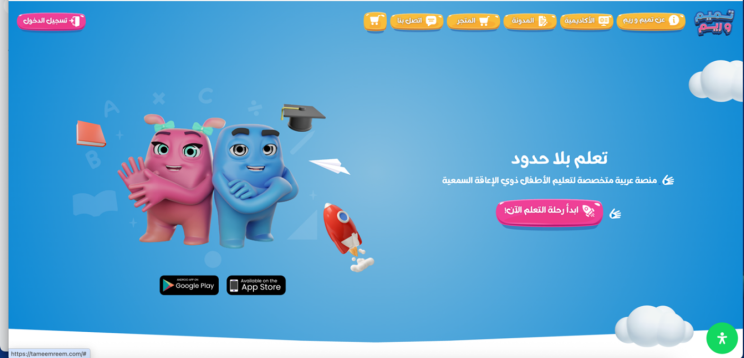 Figure 1: Home page of the Tamim and Reem platform
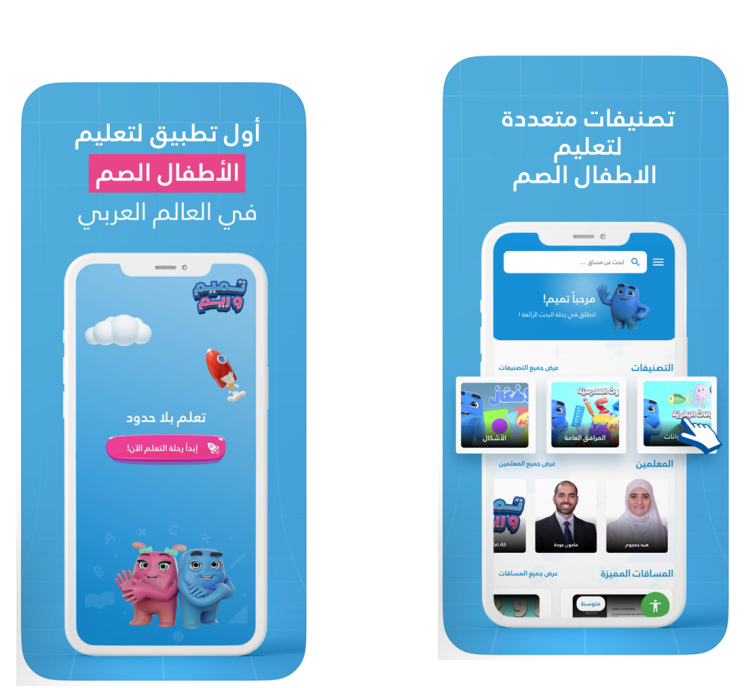 Figure 2: Images from the mobile app
Technical Preview
The platform was developed using the latest digital technologies to ensure ease of use and stable performance. A simplified visual interface was designed to suit deaf children, and frequent testing was conducted on various devices to ensure the platform is safe, stable, and accessible for all.
Challenges Along the Way
The journey was not easy. The team faced several key challenges along the way. There were no similar Arabic platforms offering educational content specifically for deaf children. There was also a lack of resources and data, as sufficient, reliable educational references were not available to build curricula. Furthermore, as a deaf person, Ma’moun had to rely on self-learning through visual and experiential learning to learn animation, a significant challenge in itself. Finally, the team faced a lack of international cooperation, as they received no response from the foreign platforms they contacted, forcing them to rely entirely on local efforts.
Despite these challenges, the platform has become a model of innovation and perseverance.
User Testing
From the early stages, the team was keen to involve the target audience in the testing process. Deaf children demonstrated clear engagement with the platform, which helped them improve their linguistic knowledge and ability to link Arabic to sign language. Parents confirmed that the platform opened a new window for them to communicate with their children in more effective ways, while teachers considered it an innovative tool that supports the educational process and adds value to classes. Dozens of volunteers, translators, and experts also contributed by providing feedback and comments, making the platform more inclusive and accurate.
Impact
The impact of the “Tamim and Reem” platform was multidimensional. It provided deaf children with a safe learning environment that speaks their language, boosting their self-confidence and increasing their ability to learn independently. It also provided speaking children with the opportunity to learn sign language, which helped promote communication with their deaf peers. On the family level, the platform provided parents with powerful visual tools to communicate more effectively with their children, while teachers viewed it as a supportive tool that enhances traditional education and adds innovative resources to classrooms.
Media Coverage
The project received extensive coverage from local and international media outlets, which contributed to strengthening its presence and giving it greater credibility with partners and supporters. The Jordanian newspaper Al-Ghad published extensive articles about the initiative [4], while Amman TV featured the story in one of its programs. TRT Arabic also highlighted the experience as one of the inspiring initiatives in the region. In addition, other media platforms such as AJ+, Jordan TV, Al-Mamlaka TV, Reuters, and local platforms such as Beit Hawa, Sahat, and the King Abdullah II Fund covered the project in their various reports, enabling its story to reach a wide and diverse audience.
The Role of Mada Center and Future Vision
Mada Center’s financial, technical, and media support has helped improve the platform’s quality and ensure its reach to a wider segment of children, parents, and teachers. The impact of this support is not limited to the current phase, but extends to enhancing the project’s future vision. “Tamim and Reem” is not just an educational platform; it is a movement for change aimed at reshaping the future of education for deaf children in the region. In the next phase, the team seeks to expand regionally to reach every deaf child in the Arab world, while developing specialized educational curricula and life skills, integrating artificial intelligence tools to support instant translation and customize learning to suit each child’s needs, and building strategic partnerships with ministries of education and Arab children’s entities.
Conclusion
What began as a small family story between Ma’moun, Heba, Tamim, and Reem has today transformed into a pioneering Arab project that restores hope to millions of deaf children. “Tamim and Reem” is not just an educational platform, but an Arab dream led by a deaf pioneer to prove that disability is not the end, but rather the beginning of an innovation that changes reality and gives children the opportunity to learn and thrive.
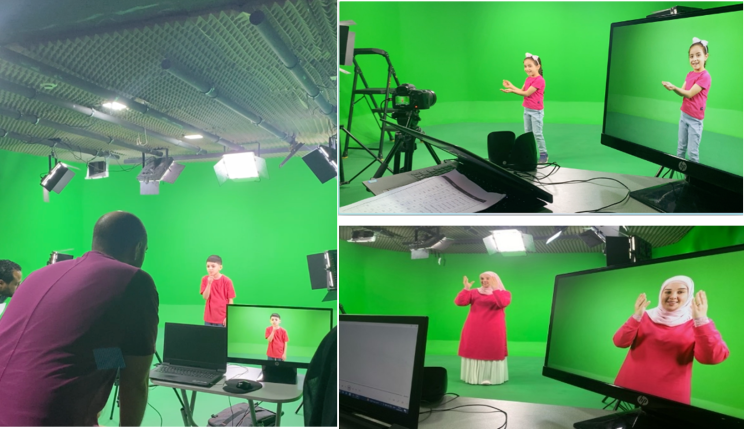 Figure 3: Behind the scenes of educational content production
Bibliography
[1] Department of Statistics, “The Reality of Disability ‘Functional Difficulties’ in Jordan, based on the data of The General Population and Housing Census 2015,” Amman, Jordan, 2021. Accessed: Sep. 24, 2025. [Online]. Available: https://dosweb.dos.gov.jo/DataBank/Analytical_Reports/Disability_2021.pdf
[2] “Jordan The world joins the celebration of the International Day of Persons with Disabilities | The Higher Population Council.” Accessed: Sep. 24, 2025. [Online]. Available: https://tinyurl.com/58textvy
[3] Shreen Hussein, “Shreen Hussien: Jordanian Deaf Role Model.,” Deaf Unity. Accessed: Sep. 24, 2025. [Online]. Available: https://deafunity.org/article_interview/shreen-hussien-jordanian-deaf-role-model/?utm_source=chatgpt.com
[4] Ibrahim Al-Mubaydeen, “A platform for people with hearing disabilities with educational cartoon content.,” Al-Ghad. Accessed: Sep. 24, 2025. [Online]. Available: https://tinyurl.com/2wnn2njn